
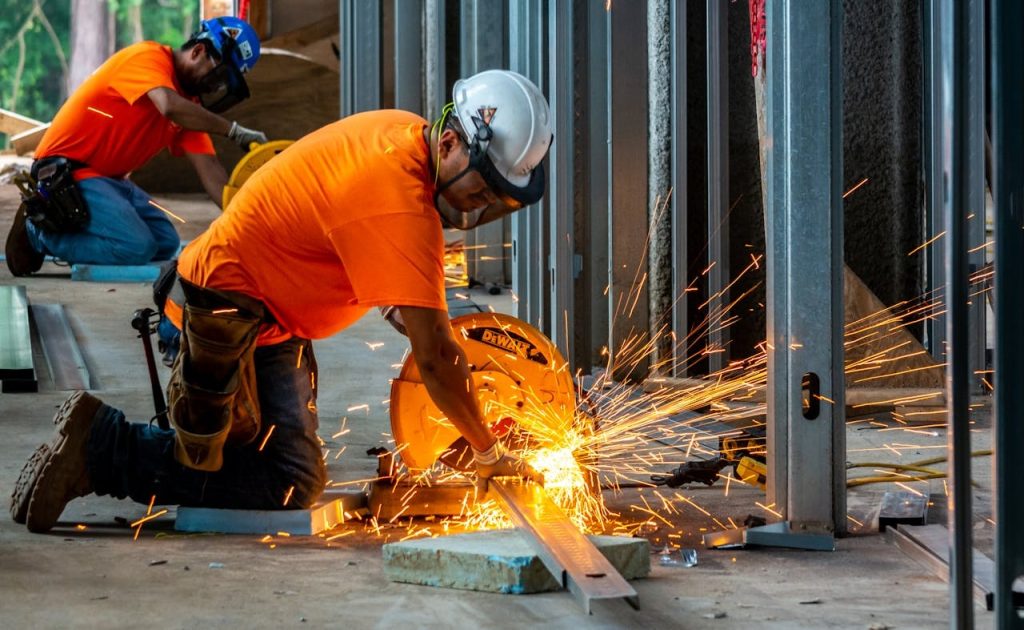
Safety when working with steel structures is not a topic to be left "for later" or solely the responsibility of the Health and Safety department. It is an area where every organisational, technical, or human error can lead to serious injuries, production downtime, and financial losses. Working with metal, machinery, and heavy structural components takes place in conditions of increased risk – especially in industrial halls and on construction sites.
That's why The combination of three elements is crucial: knowledge of regulations, a well-designed working environment, and a real safety culture.Below we discuss the most important aspects that allow for the minimisation of accident risk and the ensuring of safe working conditions with steel structures.
Safety when working with steel structures – where do the biggest risks lie?
Steel structures are present at many stages of the process – from prefabrication and metal processing, to assembly and facility use. Hazards arise where heavy elements, machinery, manual labour, and the limited space of a workshop intersect.
The most common threats include:
- mechanical injuries in metal processing
- risk of accidents during the assembly of structures,
- contact with production machinery and equipment,
- noise, dust and metal fragments
- Inappropriate working conditions in a steel hall.
The sheer scale and mass of the elements mean that work safety must be planned systematically, not ad-hoc.
Safety culture as a key element of working with steel construction
Safety culture is more than just following safety rules "on paper". It's a way of organising work, responding to hazards, and the daily decisions made by employees, operators and supervisory staff.
Looking after safety means, among other things:
- awareness of potential risks,
- emergency response capability
- the use of appropriate protective equipment
- adherence to procedures and standards
Where safety culture is taken seriously, the risk of accidents falls, and production processes are more stable.
Health and safety regulations and standards – the foundation of safety when working with metal and steel structures
Work safety on steel structures is based on specific legal regulations and technical standards. These govern the organisation of the workplace, as well as requirements for machinery, procedures, and the responsibilities of individuals.
The most important regulations and standards for safety when working with steel structures
| Legal act / standard | Regulatory scope | Practical significance | The most important provisions and obligations |
| The Labour Code (Art. 207) | Employer's responsibility for health and safety at work | The basis of the work safety system | The employer has an obligation to ensure safe and hygienic working conditions, eliminate hazards at the source, adapt protective measures to changing circumstances, and respond to employees' needs. |
| Labour Code (Art. 211) | Employee responsibilities | Daily practice at the workplace | The employee must observe health and safety regulations, use protective equipment, maintain the condition of machinery and equipment, and report any hazards or accidents noticed. |
| Labour Code (Art. 212) | Responsibilities of persons managing employees | Responsibility of operators, foremen, managers | Those in charge of employees have a duty to organise work in a safe manner, to respond to hazards, to monitor compliance with regulations and to enforce safety rules. |
| Health and Safety at Work etc. Act 1974 | Workplace and machine organisation | Health and Safety at Work (BHP) Fundamentals in Industry | It defines the requirements for the technical condition of machinery and equipment, workplace organisation, safety of production processes, marking, evacuation routes, and response to emergency situations. |
| EN 1090 | Fabrication of steel structures | Structural and assembly safety | It regulates requirements for the fabrication, inspection, and erection of steel structures, including responsibility for the quality of connections, stability of elements and safety in use. |
| PN-EN ISO 12100 | Machinery safety | Minimising risk with machinery | It indicates the principles for hazard identification, risk assessment, and the design of machines and processes in a way that limits the risk of injury. |
| PN-EN ISO 45001 | Health and safety management system | Integrated security approach | Specifies requirements for occupational safety management systems, including hazard identification, employee training, emergency response, and continual improvement. |
Knowledge of these regulations is mandatory not only for site managers but also for operators and workers performing metal processing work.
Safe steel hall and working conditions
Steel halls should be designed and operated in a way that limits the risk of accidents. Appropriate working conditions directly affect employee safety and the precision of operations performed.
The key elements of a safe hall include:
- structural stability
- clear marking of work zones,
- adequate manoeuvring space,
- Appropriate lighting and ventilation.
A poorly designed or neglected work environment increases the risk of injuries, even if employees are aware of the regulations.
Metalworking – how to limit the risk of accidents?
Metal processing is one of the most dangerous stages of working with steel structures. Metal processing work involves the use of machinery, sharp tools and high energy.
To minimise the risk:
- Machines must meet technical requirements.
- The operator should know the safety procedures and rules.
- The workstation must be adequately secured,
- Regular inspections are essential.
Modern technologies help to increase processing precision, but they do not absolve us of the duty to exercise caution.
Assembly of steel structures and particularly hazardous work
The erection of steel structures is a stage where the risk of accidents is particularly high. Work is often carried out at height, using heavy elements and transport machinery.
Safe assembly requires:
- good team coordination,
- clear procedures,
- stable points of support
- supervision of experienced individuals
Any error at this stage can have serious consequences for the health and lives of employees.
Appropriate protective equipment and work procedures
Personal protective equipment is a fundamental element of employee safety, but only when it is appropriate for the type of work and actually used.
In practice, it's about:
- helmets, gloves, eye and ear protection
- dust and noise protection
- Procedures to prevent contact with machinery.
Protective equipment will not replace procedures, but it significantly limits the effects of potential hazards.
Evacuation and Emergency Response
Even when the highest safety standards are maintained, emergencies can still occur. Therefore, an efficient response system is essential.
The basis are:
- escape routes and their signage
- regular staff training
- clearly defined roles and responsibilities
The ability to respond quickly reduces the scale of losses and protects employee health.
The safety of steel structures as an element of responsible design
Workplace safety begins at the design stage of steel structures. Taking into account health and safety, ergonomics, and technology requirements at the start of an investment helps to limit hazards throughout the facility's entire lifecycle – from construction to use.
A well-designed steel structure is not only about load-bearing capacity and durability, but also provides real support for safe production processes.
ON-TIME Solutions – safe execution of steel constructions from design to installation
If you want to be sure that the steel construction will be designed, manufactured and installed with safe operation in mind, choose a partner who takes responsibility for the entire process.
At ON-Time Solutions, we deliver steel constructions from concept and documentation, through prefabrication, to delivery and assembly. At every stage, we take care of technical requirements and health and safety standards, so you don't have to "put out fires" on the construction site or in the workshop.
Consult your project:
Call: +48 512 683 681
office@ontimesolutions.pl
FAQ – Key Safety Questions for Working with Steel Structures
Here are the most important safety rules when working with steel structures:
* **Proper Planning and Risk Assessment:** Before any work begins, thoroughly assess the risks involved. This includes identifying potential hazards such as working at heights, falling objects, unstable structures, and electrical hazards. Develop a detailed plan that addresses each identified risk.
* **Personal Protective Equipment (PPE):** Ensure all workers wear appropriate PPE. This typically includes safety helmets, safety glasses or goggles, high-visibility clothing, safety footwear with steel toe caps and puncture-resistant soles, and gloves suitable for handling metal.
* **Working at Heights:**
* Use secure scaffolding, platforms, or aerial work platforms.
* Always use fall arrest systems (harnesses, lanyards, anchorage points) when working at height where other collective protection is not feasible.
* Ensure guardrails and toe boards are in place.
* Secure all tools and materials to prevent them from falling.
* **Load Handling and Lifting Operations:**
* Only trained and certified personnel should operate lifting equipment.
* Regularly inspect cranes, hoists, slings, and shackles.
* Ensure loads are properly balanced, secured, and within the capacity of the lifting equipment.
* Establish clear communication signals between the crane operator and the banksman.
* Keep unauthorized personnel away from the lifting zone.
* **Structural Stability:**
* Never work on or around a structure that is not adequately supported or braced.
* Ensure temporary bracing is in place as per the engineer's design if the structure is not yet complete.
* Be aware of the effects of wind and weather on structural stability.
* **Fire Safety:**
* Be aware of fire risks when welding, cutting, or using hot tools.
* Have fire extinguishers readily available and ensure personnel are trained in their use.
* Clear flammable materials from the work area.
* **Electrical Safety:**
* Identify and isolate any temporary or permanent electrical installations in the work area.
* Use low-voltage tools where possible.
* Ensure all electrical equipment is properly earthed and regularly inspected.
* **Manual Handling:**
* Use mechanical aids for lifting and moving heavy steel components whenever possible.
* If manual lifting is necessary, use correct lifting techniques to prevent back injuries.
* **Edge Protection:** Securely guard all open edges of floors, platforms, and openings to prevent falls.
* **Access and Egress:** Ensure clear and safe routes for entering and exiting the work area.
* **Communication:** Maintain clear and constant communication among workers, supervisors, and other relevant parties. Use radios, hand signals, or other effective methods.
* **Site Housekeeping:** Keep the work area clean, tidy, and free from obstructions, debris, and waste materials. This reduces trip hazards and improves overall safety.
* **Training and Competence:** Ensure all personnel involved are adequately trained, competent, and have received site-specific safety inductions.
* **Emergency Procedures:** All workers must be aware of emergency procedures, including evacuation routes and first-aid provision.
The most important safety rules for working with steel structures include adherence to health and safety regulations, the use of appropriate protective measures, and proper organisation of the workplace. It is crucial to ensure safety at every stage – from metal processing and assembly, right through to the use of the structure. Safe working also requires: regular employee training and education on hazards, knowledge of work safety principles and applicable legal provisions, the use of safety procedures when operating machinery and equipment, clear marking of hazardous areas in steel halls. Adhering to safety rules helps minimise the risk of accidents and ensure the maximum safety of employees' health and lives.
Dlaczego bezpieczeństwo w obróbce metali odgrywa tak ważną rolę?
Safety in metalworking is of paramount importance, as production processes involve a high risk of injury, contact with machinery and equipment, and exposure to dust and noise. In the metalworking industry, even minor procedural errors can lead to serious accidents. Therefore, the following are crucial: strict safety rules for metalworking, the use of protective measures tailored to the type of work, regular employee training and machine inspections, the ability to respond to emergency situations. Properly designed production processes and compliance with health and safety regulations help to reduce risks and maintain high work precision.
A steel structure fitter's job involves assembling and erecting steel frameworks for buildings and other structures. This includes tasks like reading blueprints, cutting and shaping steel components, bolting or welding pieces together, and ensuring the structural integrity and safety of the completed assembly.
The work of a steel structure erector involves assembling, joining, and stabilising steel elements according to technical documentation and applicable regulations. The erector often carries out work in steel halls or at heights, using machinery and transport equipment. The scope of duties includes, among others: preparing and inspecting construction elements before assembly, safely carrying out the assembly of steel structures, co-operating with machine operators and technical supervision, responding to potential hazards and emergency situations. Knowledge of safety principles, appropriate employee training, and adherence to legal regulations are crucial for the erector to be able to respond correctly and ensure the safety of themselves and others on the construction site or in the production hall.
 English (UK)
  Polski
  Deutsch
  Svenska
  Norsk bokmål