
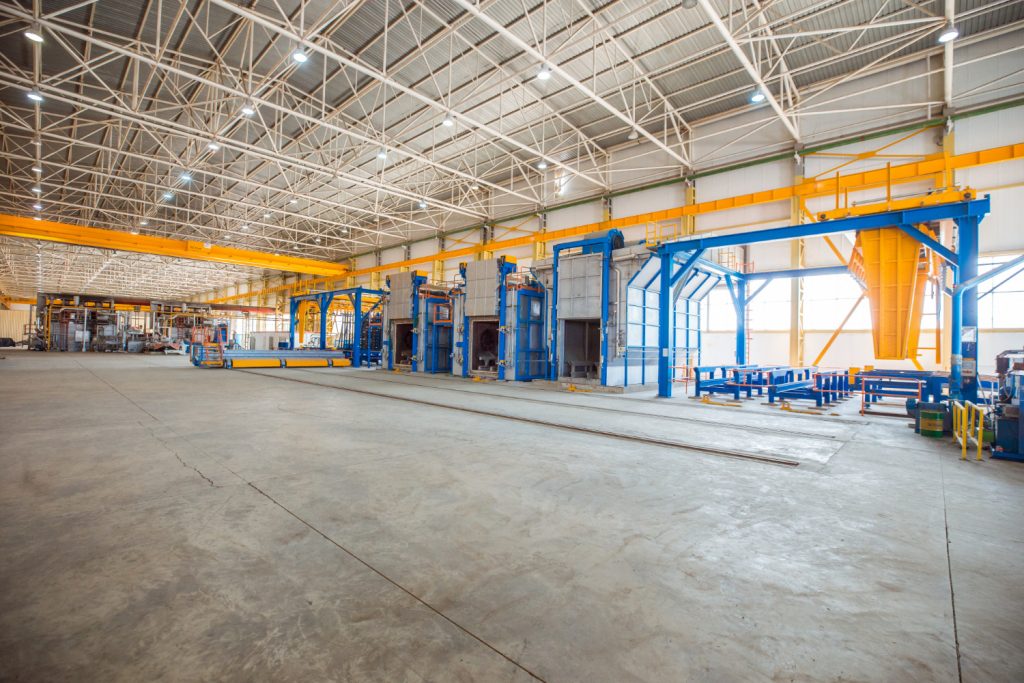
Industrial hall construction This is an investment of strategic importance for any enterprise operating in the industrial sector. For the hall to fulfil its function safely, efficiently, and in compliance with current law, it must meet a range of formal and technical requirements. In this article, we will discuss the most important regulations, standards, and guidelines related to Construction of a production hall, focusing on issues BHP, safeguards fire safety, floor load capacity and installation layout.
Production hall and legal requirements – what does building law say?
Every The production hall must meet specified requirements arising from the regulations Building law, regulations concerning the technical conditions that buildings must meet, and Polish Standards. Of key importance is Adapting the hall to the type of industrial activity conducted, and also the possibility of later extensions and flexible adaptation to the changing needs of the enterprise.
In the context of constructing a production hall, it is also important to meet environmental requirements and obtain the necessary permits – from the environmental decision to the building permit. The construction of the hall, most often Steel skeleton, should provide adequate load capacity, resistance to dynamic and static loads, as well as protection against adverse weather conditions.
Construction and technical standards – what must a design take into account?
Technically speaking production hall should be designed with the future in mind extensionas well as enabling easy reorganisation of space. The typical layout of a facility includes zones Production, warehouse, Office and Social.
The key design aspect is floor load capacitywhich should be adapted to the type of machinery and intensity of internal traffic. In industrial halls, it is worth using industrial flooring with a load capacity of at least 5 tons/m², with the possibility of increasing this parameter depending on needs.
In turn Thermal insulation building partitions has a direct impact on work comfort and Construction costs in operation. The applicable technical conditions assume very stringent heat transfer coefficients (U), e.g.:
- Roof: U ≤ 0.15 W/m²K
- Walls: U ≤ 0.20 W/m²K
- Floor: U ≤ 0.30 W/m²K
- Windows: U ≤ 0.90 W/m²K
- Doors and gates: U ≤ 1.30 W/m²K
The most commonly used materials are sandwich panels with a polyurethane foam or mineral wool core, as well as XPS foam board in the floors.
Health and Safety at Work (HSW) – employer's responsibilities
Each employer planner Construction of the hall The industrial [sector/company] has a duty to provide employees with adequate working conditions Compliant with regulations Health and safety at work.
Basic health and safety requirements include:
- Welfare and sanitary facilities – in workplaces employing more than 10 people, separate toilets for men and women are required, dining roomchanging rooms and washrooms.
- Minimum room height social areas: 2.5 m (or 2.2 m in basement and cellar levels).
- Workplace lighting – at least 12.5% of floor area should be lit by daylight. An alternative is appropriately designed artificial lighting.
- Ventilation and air exchange – efficient gravitational or mechanical ventilation is required, especially in halls with increased dust and gas emissions.
- Operating temperature - for light work, a minimum of 18°C; for heavy work, 14°C. Rooms for rest in the open air should provide 16°C.
Fire safety precautions – what you need to know?
In every production hall, it is necessary to comply with regulations. fire safetyThe requirements vary depending on the type of business, the materials used, and the location of the facility in relation to neighbouring buildings.
Fire safety requirements include:
- Division of the hall into fire zones and the use of non-combustible or flame-retardant materials.
- Fire protection systemssuch as: sprinklers, internal hydrants, smoke detectors, smoke extraction systems.
- Clearly marked evacuation routeswhose width and number must correspond to the number of employees and the size of the hall.
- In the event of increased fire risk, it is worth considering the use of construction reinforced concrete Love Hybrid (reinforced concrete-steel), which guarantees a higher level of protection.
Technical installations – functionality and safety
In every Production hall plays a key role the correct installation layoutwhich affects both production efficiency and personnel safety.
The required installations are:
- Electrical installationadapted to the power of machines and equipment, with surge and lightning protection.
- Plumbing and sewerage system, necessary for the operation of welfare and production facilities.
- Heating and ventilation system, ensuring a suitable working microclimate and complying with minimum temperature regulations.
- Access control and monitoring systemespecially in highly automated plants.
The proper planning of installation routes should allow for their subsequent Assembly, service and modification in the case of extensions object.
The costs of building a production hall – what do they depend on?
The cost of building a production hall depend on many factors – including usable floor area, type of construction (Steel(reinforced concrete, or hybrid), the level of technical equipment, and the location of the investment.
The most economical solution is Steel hallswhich are characterised by short lead times and relatively low unit costs. For halls with increased fire protection requirements, costs may increase due to the necessity of using fire-resistant materials and specialised protection systems.
Also standard Social i Office The object influences the final investment price. Modern facilities increase work comfort and promotes team efficiency, but comes with additional costs
Summary – Key Requirements for Industrial Halls
Every modern production hall This is a space that must be designed with safety, efficiency, and regulatory compliance in mind. Industrial hall construction requires consideration of design standards, requirements BHPrecipes fire safety, as well as thermal, acoustic and lighting conditions.
Key aspects include:
- Compliance with building regulations the standards relating to construction, insulation and lighting.
- Health and safety at work – adapting the space to employees' needs.
- Effective fire protectiontailored to the specific nature of the business.
- Optimal installation layout, supporting efficiency and work comfort.
- Future possibility extensions and flexible space management.
Investment in a professionally designed and executed industrial hall the foundation of development for any manufacturing business – both operationally and strategically.
FAQ - Frequently asked questions
What requirements must a production hall meet?
Production hall must meet specified standards resulting from regulations construction, BHP and regulations fire safety. They concern, among other things, construction, hall heightthermal insulation, ventilation, lighting, and room facilities hygienic-sanitary.
What are the temperature requirements for the production hall?
In the event that A continuous effort is being made, Temperature in the hall cannot be lower than:
- 18°C for light physical work or office,
- 14°C for strenuous physical labour.
The heating system must ensure stable thermal conditions indoors regardless of external conditions.
Does a modern production hall need to be illuminated by natural light?
Yes. If The work lasts over 4 hours a day., we must ensure daylight illumination – windows or skylights should be at least 12.5% of floor area. The exception is the workstation exposed to UV radiationwhere natural lighting can be excluded.
What welfare facilities must be provided in the hall?
If You are planning to build a production hallYou must provide employees with access to toilet, toilet, edible and washroomThese requirements vary depending on the number of employees and their gender. These rooms must comply with Hygiene and sanitary working condition regulations.
Does a production hall need fire protection?
Dependencies for fire safety requirements, the type of production and materials used in the hall, it may be necessary to use:
- fire walls,
- sprinkler systems,
- smoke detectors
- evacuation routes
In some cases, small halls with a low fire risk do not require special safety measures; however, every hall must meet safety requirements.
What are the requirements for hall height?
Minimum Hall height The production output is:
- 3 metres in light of standard bets,
- 3.3 metres for objects emitting dust and gases,
- more if cranes or other machinery requiring manoeuvring space are used in the hall.
Appropriate height is conducive to production process efficiency and optimal use of space.
What standards apply to the thermal insulation of halls?
In the case of heated production halls, strict Thermal insulation requirementsFor example:
- roof: U ≤ 0.15 W/m²K,
- Walls: U ≤ 0.20 W/m²K.
Meeting these requirements affects work comfortand reduces energy consumption and operating costs.
 English (UK)
  Polski
  Deutsch
  Svenska
  Norsk bokmål