
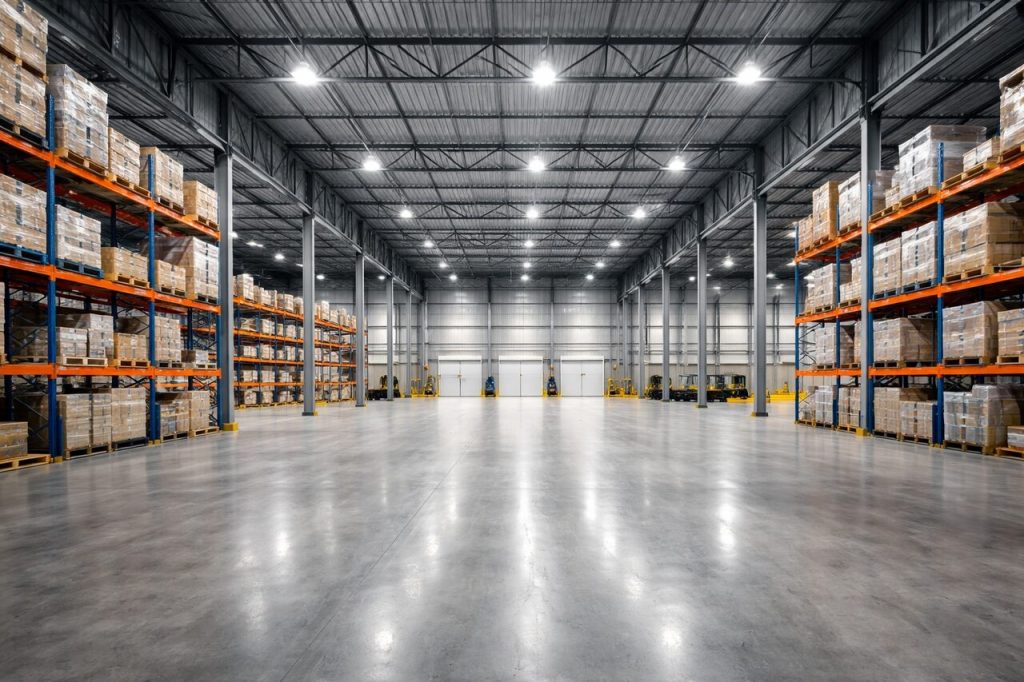
Steel warehouse halls are one of the most sensible solutions for businesses today that require efficient, flexible, and scalable storage space. In a dynamically changing logistics environment, not only the construction cost counts, but also the lead time, the possibility of expansion, and the ability to adapt the facility to future business needs.
A steel warehouse hall offers an advantage that is often not immediately apparent – it allows for a quicker start to operations, easier space reorganization, and seamless expansion of the investment in subsequent stages. Check why it's worth opting for this particular solution and what less obvious benefits it can bring to your company.
1. The speed of constructing a steel warehouse – a real business advantage
One of the most frequently cited reasons why investors choose steel warehouse buildings is the speed of project completion. Compared to traditional construction technologies, the construction of steel halls proceeds much more efficiently – both during the prefabrication of elements and later during assembly on the construction site.
The construction of the hall does not start from scratch on-site – it is prefabricated beforehand, and assembly takes place at the investment location. This significantly reduces the execution time. In practice, this means:
- shorter construction time compared to masonry buildings,
- quick erection of the structure and making the building watertight
- possibility of an earlier start to business operations or rental of space,
- Limiting the costs of operational downtime.
In logistics and warehousing, time has a direct impact on revenue. The faster a warehouse is made available, the sooner it can start generating value. – whether we are talking about our own warehouse or a facility intended for logistics centres.
2. Lower investment cost and better budget control
Choosing a steel warehouse is not just a matter of "cheaper construction". It is primarily about greater cost predictability and a lower risk of the budget spiralling out of control during construction.
The construction of steel halls is based on prefabricated elements and a precise hall design, which allows to precisely define the scope of work before the investment beginsThis limits the risk of unexpected material or technological changes.
An additional benefit is lower foundation costs. Steel structures are lighter than traditional masonry buildings, meaning less load is transferred to the ground, and therefore often less complex and cheaper foundation solutions.
For an investor, this means:
- Better budget control,
- greater transparency of costs
- the possibility of optimally planning investment financing
- Limiting the risk of exceeding the set construction budget.
This is particularly important for larger projects, such as warehouse constructions or logistics facilities.
3. Maximum flexibility of storage space in modern steel halls
This is one of the biggest, and often underestimated, advantages offered by modern steel halls. Thanks to large structural spans, it is possible to design column-free spaces, which significantly increases the functionality of the building.
The absence of internal supports allows:
- freely plan the layout of the shelves
- Adapt the warehouse for high-bay storage.
- To make changes to the spatial organisation without structural intervention,
- easy to integrate automated systems and solutions for logistics.
4. Ease of future expansion and modification
The argument that many investors only think about after several years of using the property.
A steel-technology warehouse can also be easily expanded in the future. It is possible to add another nave, extend the building, or adapt it to the investor's changing needs.
This makes the hall not a rigid, one-off investment, but rather a flexible business development toolIn practice, steel structures "grow" with the company – without the need to build an entirely new building from scratch.
Steel structures allow for:
- to the construction of further naves without interfering with the functioning part of the building,
- raising the roof in case of a change in the storage system,
- change of purpose of a building (e.g. from warehouse to production hall),
- partial dismantling and relocation to another site.
The object can be modified depending on business development, new contracts, or changes to the operational model.
This is a huge advantage over traditional technologies, where expansion often means a costly rebuild of the entire structure.
5. Internal logistics optimisation
A warehouse is not just a storage space – it's a part of a company's logistics system. That's precisely why steel-frame warehouse constructions offer so much design freedom.
It is possible:
- easy design of loading docks and receiving areas,
- integration with ramps, industrial gates, and loading systems
- flexible planning of traffic lanes for trolleys and internal transport,
- Introduction of warehouse automation and high-bay storage systems.
Large spans and the absence of intermediate columns allow for the optimisation of goods flow. And in logistics, every second counts – shortening the operational route translates into real savings.
6. Technical parameters tailored to the investor's storage needs
When it comes to a warehouse hall, it’s not just about "solid construction". The key is to match the technical parameters to the specific storage model.
Modern steel halls enable:
- design of structures for specific loads of shelving and warehouse systems
- adaptation of roof load-bearing capacity for technical installations or photovoltaic panels,
- the use of sandwich panels providing adequate insulation,
- temperature control for the storage of sensitive goods.
This means that A warehouse hall is being built based on the investor's real needs, rather than as a universal, "template" building..
7. Long-term durability and low maintenance costs of the building
A well-designed steel warehouse is an investment for years to come. Steel structures protected against corrosion are characterised by high durability and weather resistance.
Long-term benefits include:
- limited renovation costs
- reduced structural unreliability,
- stability of performance parameters
- long object lifespan.
In practice, this means lower maintenance costs over the entire service life. And it is precisely the operating costs that determine the long-term profitability of an investment.
8. Aesthetics and Company Image – An Underestimated Element of Steel Warehouse Project Design
Although a warehouse hall is primarily associated with functionality, its appearance matters – especially when collaborating with contractors, logistics companies, or business clients.
Modern steel halls allow for:
- aesthetic facade finish
- visual consistency with the office part,
- colour scheme and detail matching for brand identification
- building a company's professional image.
A warehouse facility is often a contractor's first point of contact with a company's infrastructure. A robust, modern building enhances the perception of the business as a stable and well-organised partner.
9. Investment scalability – from a small steel warehouse to a logistics centre
Steel warehouse buildings are suitable for both smaller investments and large logistics projects.
This technology allows for the implementation of:
- a small warehouse building for a local company,
- High bay warehouse
- extensive logistics centres,
- Phased investments, carried out in several stages.
This allows the investor to start with a smaller area and expand the facility as demand grows.
10. Steel warehouse halls as a strategic decision, not just a construction one
Choosing a steel warehouse building is not just a technical decision. It's a business decision that affects:
- operational flexibility
- predictability of implementation
- investment scalability
- long-term profitability.
A steel warehouse hall provides an advantage that is often not visible at the design stage, but which becomes crucial during the development of a company.
If you're planning to build a warehouse facility, it's worth looking at this investment more broadly – not just from the perspective of construction costs, but also its impact on the functioning of the entire business.
ON-TIME Solutions – we will design and build your steel warehouse comprehensively
If you are planning to build a steel warehouse hall, not only technology is crucial, but also the choice of a partner who will guide you through the entire investment process.
ON-TIME Solutions manufactures steel warehouse halls from concept to assembly. We provide:
- Bespoke design tailored to storage and logistics needs.
- cost and future expandability optimisation of the construction,
- production of structural elements in a controlled environment,
- anti-corrosion protection adapted to the working environment
- logistics and assembly in accordance with the schedule,
- full coordination of technical documentation.
Thanks to a comprehensive approach, the investor gains one responsible party for the entire implementation – without chaos, without scattered competencies, and without uncontrolled delays.
Are you planning a steel warehouse building?
Let's discuss your investment and tailor a solution to your business's real needs.
+48 512 683 681
📩 inbox@ontimesolutions.pl
FAQ – frequently asked questions about steel warehouse buildings
Can a hall be erected without a permit?
This depends on the size and intended use of the building. In most cases, a warehouse hall requires a building permit, especially if it is a year-round, permanently fixed structure with a load-bearing structure based on foundations. However, there are situations where smaller, temporary structures can be built based on notification. The design of the building, its area, height, and the requirements of the local development plan are of key importance here. Therefore, before starting the investment, it is worth checking the development conditions for the specific construction site and consulting with a specialist. Every steel hall should be constructed in accordance with applicable regulations to avoid formal issues in the future.
Which is cheaper: a steel hall or a brick building?
In most cases, a steel hall is cheaper than a brick hall – both at the construction stage and in long-term operation. Steel is a material that allows for the prefabrication of structural elements, which shortens assembly time and reduces labour costs. Additionally, a lighter supporting structure means less load on the foundations, resulting in lower earthworks costs. Brick halls often require more materials, a longer implementation time, and more extensive supports and load-bearing walls. As a result, the completion date is extended, and the investment budget becomes less predictable. Of course, the final cost depends on many factors – the area, finish standard, or function of the facility – but in practice, building a steel hall is a more economical and flexible solution.
Which steel warehouse halls should I choose?
The choice should be tailored to the client's needs and the specific nature of the business. Each steel hall can be customised in terms of span, number of columns, storage height, and type of cladding. When choosing, it is worth paying attention to: functionality and ease of use, planned method of goods storage, possibility of later expansion, technical requirements related to roof and structural load-bearing capacity, optimal working conditions (e.g. insulation and ventilation). A well-designed warehouse hall is not a universal template, but a facility adapted to the investor's needs. A properly prepared project allows for the combination of a solid structure with flexibility of use and predictable costs.
 English (UK)
  Polski
  Deutsch
  Svenska
  Norsk bokmål